Redefining Workflows with Microsoft AI & Power Platform: Start with Business Goals, Not Technology

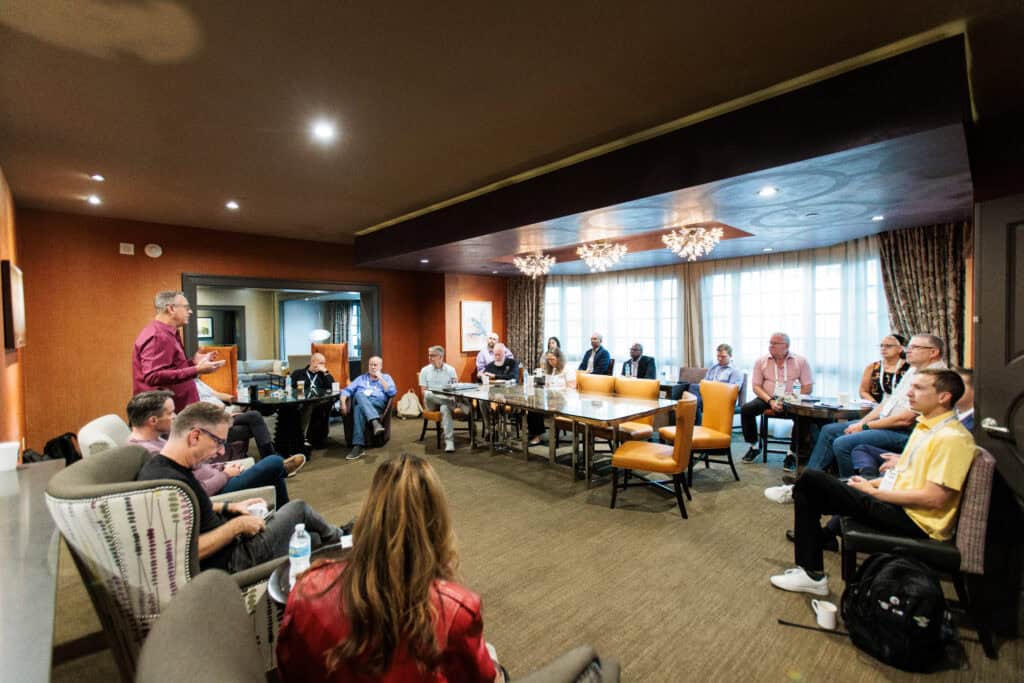

At this year’s Community Summit NA, the executive roundtable “Redefining Workflows with Microsoft AI & Power Platform“, underwritten by Innovia Consulting, brought together business and technology leaders to explore AI adoption, workflow automation, and how organizations can turn emerging technologies into measurable business value.
The discussion featured Leon Welicki, VP and GM of Power Platform at Microsoft; Dona Sarkar, Chief Troublemaker, Microsoft Enterprise AI Advocacy; and Shawn Dorward, Chief Operating Officer at Innovia Consulting. The conversation was moderated by Dewain Robinson, VP of AI Analysis & Training at Dynamic Communities, and John Siefert, CEO of Dynamic Communities and Cloud Wars.
Adoption and Adaptation Go Hand in Hand
A key theme was that AI adoption and organizational adaptation must go hand in hand. While technology is evolving rapidly, organizations can only realize its full potential by rethinking processes, challenging ways of working, and preparing for the next generation of employees.
One attendee captured this idea when discussing the future of work at their organization: “My ceiling will become their floor.” What organizations achieve with AI today can become the starting point for the next generation, creating opportunities to build on existing progress.
For attendees unsure where to begin, the panel offered reassurance: It’s not too late to start. Organizations can learn from others, identify practical use cases, and focus on applications that deliver tangible business value.
However, getting started doesn’t mean accelerating adoption at all costs. Sarkar emphasized the importance of knowing when to move on from tools or approaches that aren’t delivering results. Organizations must be willing to reassess their choices and adapt rather than keep going just because they have already invested time and effort.
Start with Clear Business Goals
Welicki stressed that realizing value from AI begins with a clearly defined business objective. While technology and tools will continue to evolve, organizations need a consistent understanding of what they want to achieve.
That means defining the business problem, establishing shared goals, and aligning people and processes around the desired outcomes. With a clear strategy in place, organizations can adapt as new AI capabilities emerge without losing sight of their priorities.
The panel also explored the difference between traditional automation and generative AI. Not every task requires an AI model, and using one unnecessarily can add cost and increase complexity.
Sarkar offered a simple way to think about the difference: If the same question should produce the same answer every time, automation may be the better choice. If a task requires interpretation, reasoning, or a response that changes depending on who answers, generative AI may be more appropriate.
Many workflows will benefit from a combination of both. The key is to identify where AI adds genuine value rather than using it for every task.
Keeping the Human Element at the Center
The discussion also highlighted the importance of people in successful AI adoption. While AI can enhance employees’ capabilities, organizations still need people who understand the tools and how to apply them effectively.
Sarkar highlighted two approaches to adoption: leadership-driven, where leaders demonstrate AI’s value and encourage others to follow, and organic, where adoption develops haphazardly across teams and individuals.
The takeaway was clear: Leaders have an important role to play in making AI adoption successful. By setting an example, establishing clear expectations, and embedding AI into the team’s culture, they can help employees move beyond experimentation and toward meaningful, *shared* progress.