The Full Reckoning: What Expires, What Endures, and What to Do Now



Seven articles in, you’ve been handed a lot of separate decisions: which clock you’re actually on, what keeps the platform underneath GP current, how to prove you can recover, how to govern change instead of fearing it, how to settle the one compliance deadline with a government on the other end, how to find the value you’ve already paid for, and who to trust with the parts you can’t do alone. This piece puts them back together. It’s the ledger the migration pitch never shows you in full — what genuinely expires, what endures, and what’s worth doing first.
What the Series Argued
The premise running under all seven prior pieces is simple, and mildly contrarian in a market full of migration urgency: Staying on Dynamics GP is a legitimate, defensible posture — when it’s deliberate rather than drifting. Not a delay tactic, not a failure to decide, but a choice you can stand behind, run safely, keep compliant, and keep extracting value from for years.
Everything rests on one distinction, first named in Decide or Drift: The Choice Behind Every GP Deadline: the application freezes, but the platform underneath it doesn’t have to. GP (the product) stops changing after Microsoft’s dates. GP (the environment) — the database, the operating system, the hosting, the backups, the security boundary, the reporting layer above the data — stays entirely within your control, on your own schedule. Drifting is running an aging system because nobody decided otherwise. Deliberate operation is knowing exactly what expires, deciding what to do about each piece, and building what covers it, on purpose.
The Honest Ledger
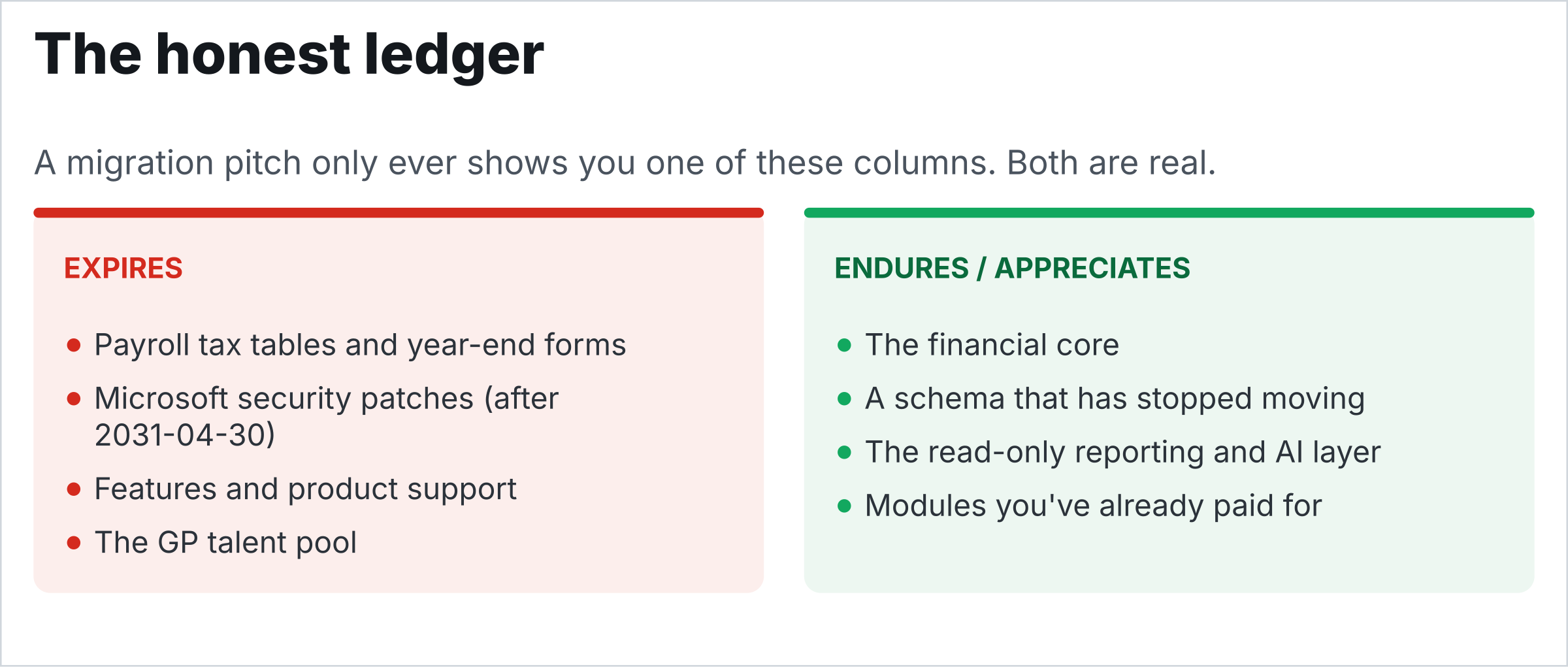
The clearest way to hold the whole picture is two columns: what expires and what doesn’t. A migration pitch only ever shows you the first one.
Expiring: Microsoft’s product enhancements and technical support, tax-year content and the GP builds that used to widen your platform options, and the pool of people who genuinely understand this ecosystem — shrinking on its own timetable rather than a published one. Enduring, or actually appreciating with time: the financial core itself, untouched by any of the above; a schema that stops moving, which for a reporting and AI layer is a foundation rather than a liability; the modules already sitting paid-for and dormant in your install; and a properly isolated, well-governed environment, which is the kind of control that outlives a patch stream rather than depending on one.
The whole argument of this series is that the second column is larger than the migration conversation — and that every line in the first column has an answer you can build or buy, deliberately, before it becomes urgent.
How the Pieces Interlock
Each article in this series stands alone, but they aren’t a menu; they support each other.
Keep the Platform Current and Govern What Changes are the same discipline applied to two directions: know your clocks and confirm every dependency before you touch any of them.
Prove You Can Recover is what makes that discipline survivable when a change goes wrong anyway, and what makes an unpatched, isolated environment defensible rather than merely hoped-for.
Own Your Compliance is the one deadline among all of this with a government, not just Microsoft, on the other end which is why it gets solved first, not last.
Get More From What You Own is the reminder that this whole posture isn’t only defense; there’s real, already-purchased value sitting idle in most GP installs, and an ISV ecosystem that was always where the platform’s real innovation lived.
And Choosing Help is the pillar underneath all the others, because none of the rest works without a bench you can call on when a problem outruns what your own team can solve.
Notice what’s common to all six operational pieces: None of them depend on Microsoft shipping anything further. They depend on you — which is exactly the posture a shop capable of staying deliberately must be capable of holding.
What To Do First
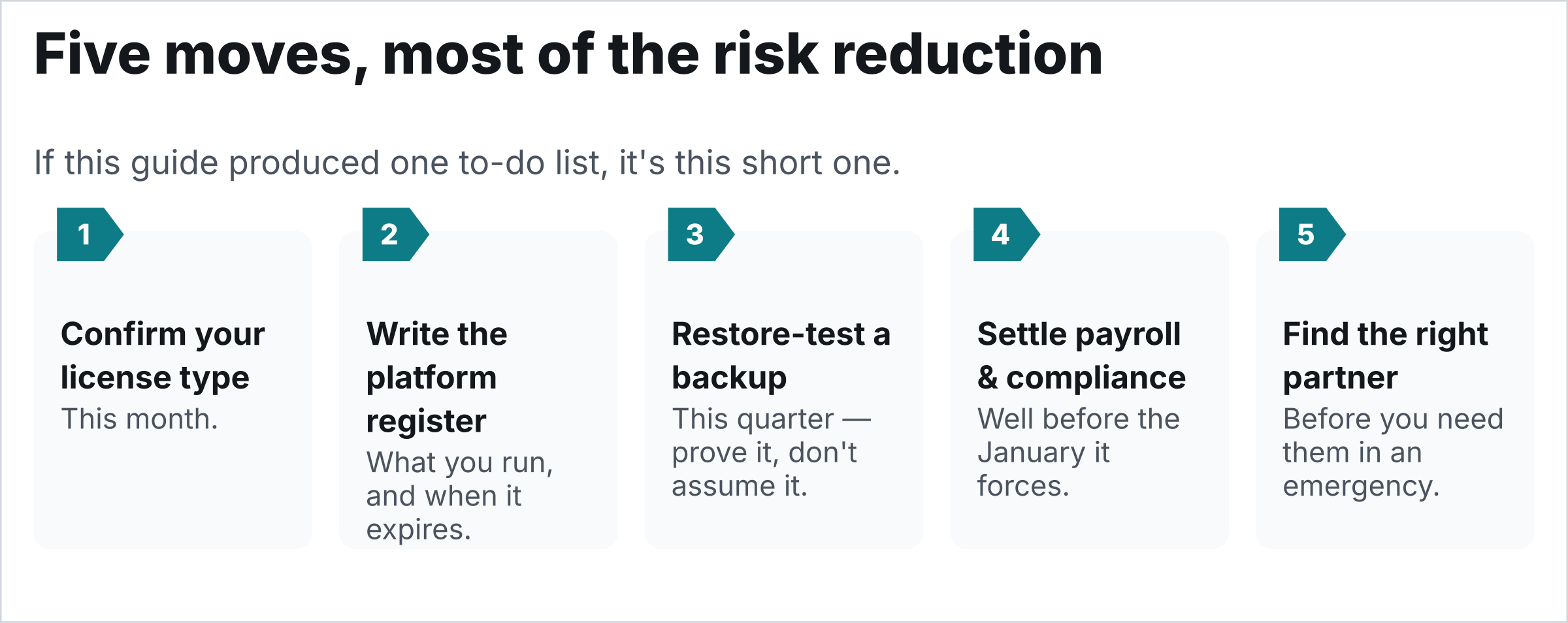
If this series produced one to-do list, it’s short:
- Confirm your license type this month, because it decides which clock you’re on and nothing else in this list matters until you know the answer
- Write down what you’re running and when each platform layer expires — that single document turns “we’re fine until 2029” from an assumption into something checkable
- Restore a backup this quarter and prove GP actually comes up on it, rather than trusting a dashboard that only tells you a job didn’t error out
- Settle your payroll and compliance path well before the January it forces on you
- Find the partner whose business survives your staying, before you need them in an emergency rather than a planning meeting
None of these five is large on its own. Together, done deliberately and on your own timeline, they’re the difference between a shop that’s still making genuine choices in 2032 and one that’s discovering, all at once, everything it never decided.
The Bottom Line
The migration conversation is built to feel inevitable. It isn’t. For a shop that has confirmed its license permits the choice and operates on purpose, GP can be run safely, kept compliant, and kept valuable well past the dates that are meant to end the discussion — not by pretending nothing expires, but by knowing exactly what does and building the systems that cover it.
Keep the financial core. Keep the platform underneath it current. Know your dates, prove your recovery, and don’t do any of it alone. That’s the whole case this series has made, and it’s one you can stand behind.