Own Your Compliance: The One Deadline You Can’t Quietly Miss



Everywhere else in this series, the day after support ends looks mechanically identical to the day before it. Payroll, 1099s, and sales tax are the exception, and the reason is the calendar. Tax law changes every year whether or not your software vendor is still shipping updates. Withholding rates move. Form layouts get renumbered. A supported product absorbs all of that on a schedule; an unsupported one doesn’t, and the first missed update isn’t a cosmetic gap — it’s a withholding calculation or a filing that’s quietly wrong until someone notices, usually a government agency.
That’s what makes this the sharpest edge in the whole post-2029 story. It’s also, looked at squarely, the most solvable one. Knowledge loss has no vendor to buy your way out of. This does.
What Actually Stops
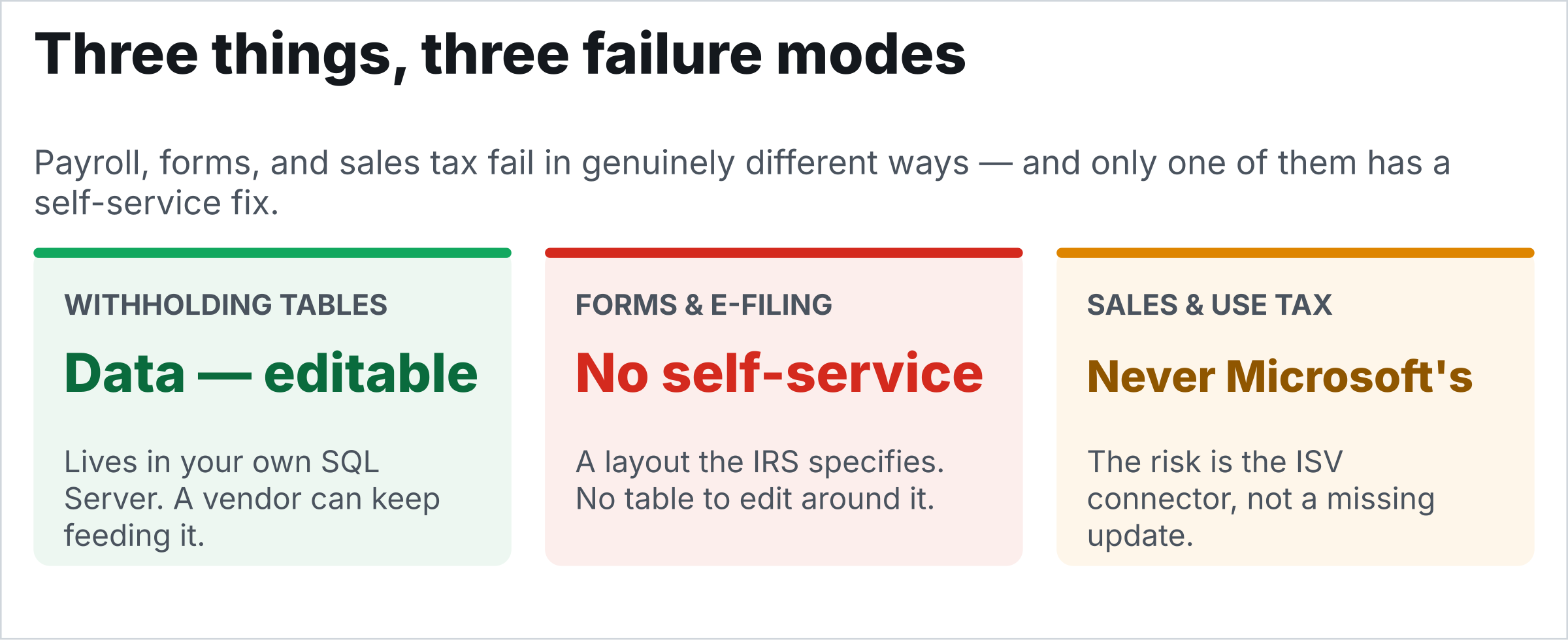
The instinct is to lump every tax-adjacent function into one worry. Don’t — they fail in genuinely different ways, and the difference decides what fixes each one.
Payroll withholding is data: rate tables, brackets, and wage bases that live in your own SQL Server and are editable through GP’s own interface. That’s the door that makes independence possible at all — a third party, or in principle you, can keep pushing new numbers into those tables long after Microsoft stops. But two things sit underneath that door and don’t move with it. Forms and e-filing — the W-2, the 1099s, the electronic file formats the IRS and SSA specify — aren’t in those tables at all; they’re a separate layer Microsoft ships once a year, and there’s no number to hand-edit your way around a redesigned form. And when a state changes not a rate but the shape of its withholding math, the fix is a rebuilt GP, not a table edit — which is a ceiling no amount of self-maintenance can climb over once GP’s builds stop.
Sales and use tax sits in a third category entirely, and it’s worth knowing this clearly because it changes the whole shape of the worry: Microsoft never shipped sales-tax content at all. Your rates and jurisdictions have always been yours to maintain, or a third-party tax engine’s. Nothing about that changes in 2029. What matters there instead is whether the connector linking that engine to GP keeps working through every platform move — an ordinary ISV-dependency question.
The Part That Should Take the Edge Off
Here’s the reframe that matters most: GP has never handled the hardest part of this alone. Out of the box, it doesn’t e-file W-2s or 1099s, doesn’t distribute employee copies electronically, doesn’t validate a Social Security number against government records. With the IRS’s e-file threshold now down to ten forms, essentially every GP shop already runs a third-party vendor for exactly this layer. Buying compliance past 2029 isn’t a new crutch adopted because Microsoft is leaving. For the forms-and-filing half of the problem, it’s the crutch you’ve been standing on for years. What changes is mostly a matter of extending that same relationship to cover the withholding-table half too, and deciding whether GP’s payroll engine stays in the middle of the calculation at all.
That decision has three honest shapes: keep GP doing the calculation and buy the compliance content around it, which is minimal disruption but leaves the calculation-code ceiling in place; move the payroll engine itself out to a dedicated platform while GP keeps the financial core, which is a real project but removes that ceiling entirely; or maintain the tables yourself, which is workable only for the smallest, simplest, single-jurisdiction shop and a genuine trap for almost everyone else, because nobody validates your output against the agencies that will ultimately judge it.
Whichever shape a shop picks, one question outranks all the others when evaluating who to lean on: who validates your output with the government, and how do you prove it? Not who writes a number into a table — who confirms the IRS, the SSA, or a state revenue agency will actually accept what the software produces, in the exact format they specify. That validation is the real product a compliance vendor sells, and it’s the one thing self-maintenance structurally cannot replicate.
Why This Can’t Wait For a Quiet Quarter
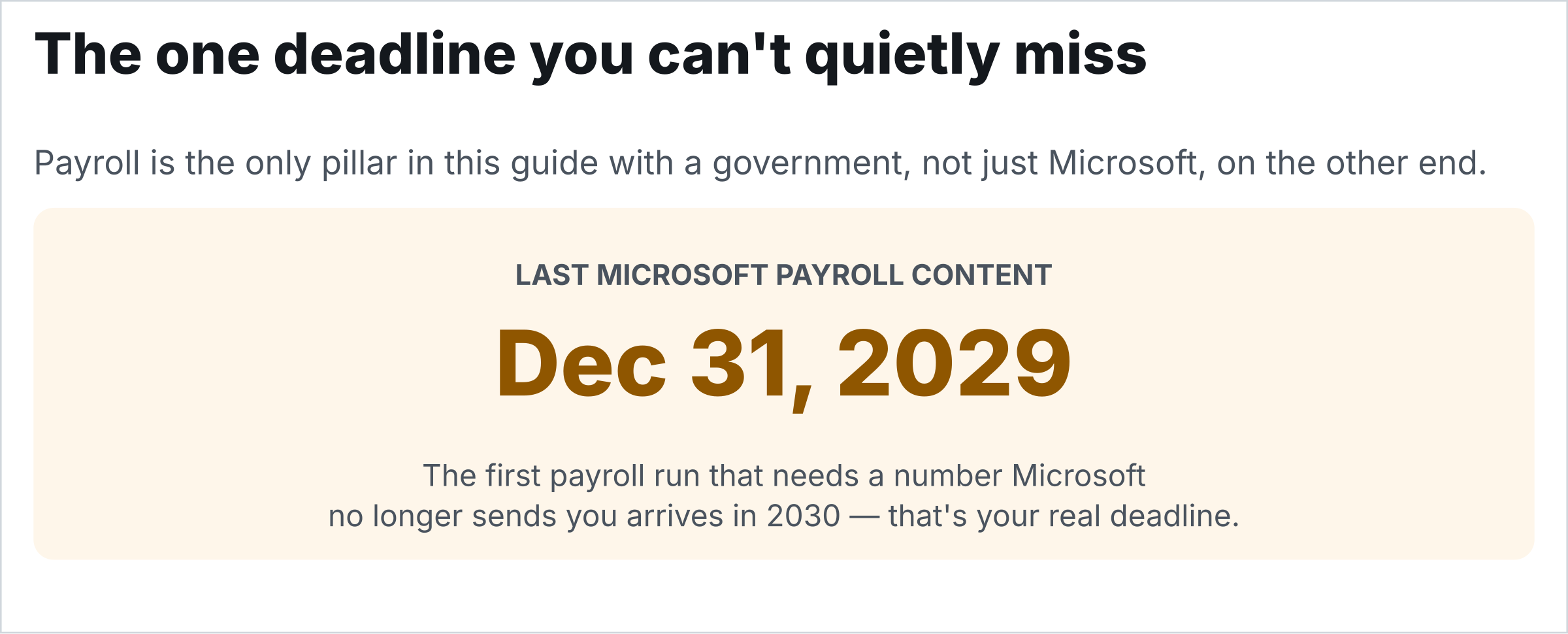
Every other pillar in this series can be phased on your own schedule. This one can’t, because it has exactly one natural cutover point: the year boundary. A January start against a cleanly closed prior year is a manageable transition; a mid-year switch with split year-to-date totals and two systems both claiming a piece of the same W-2 is not. Working backward from that, the last clean start before a shop would be producing its own year-end content unassisted lands in January 2030 — which means the decision itself wants to be settled well inside 2029, as a rehearsed move rather than a scramble.
The good news is that payroll is one of the few things in this whole series you can prove correct before you depend on it. Restore a live company into a test environment, run the new approach in parallel against a real GP payroll run, and compare the results check by check before committing to anything live.
The Bottom Line
This is the one pillar where drift shows up as a penalty notice rather than a slow accumulation of risk, which is exactly why it earns first priority among the operational decisions in this series. But the dependency it exposes is bounded, well understood, and already being carried by mature vendors competing for the business — most of whom you’re probably already paying for half of it. Confirm today whether your existing forms vendor covers you past 2029, decide deliberately whether GP’s payroll engine stays in the loop or moves to the edge, and get the answer settled before the year that makes it urgent. Resolve this one on your own terms, and the sharpest edge in the whole post-2029 story goes dull.