Choosing Help: The Partner Search You Have to Run Backward



Every other decision in this series is about systems you control — your license, your platform, your backups, your own discipline. This one is about a relationship you can’t build alone: the people you call when something goes wrong that your own team can’t solve. Deliberate doesn’t mean self-sufficient. Sooner or later, a payroll run breaks the week before a deadline, or a platform move behaves in a way your customization didn’t expect, or the one person who understood an integration walks out the door. When that happens after Microsoft’s dates have passed, there’s no vendor support line to call. Your partner is it — which makes the partner you choose one of the highest-leverage decisions in the whole plan, because getting it wrong quietly undoes the good work everywhere else.
Why the Ordinary Search Gets This Backward
Normally, choosing a partner is a search for capability and price: find someone competent, compare rates, check references, sign. For a shop that’s decided to stay on GP, that ordinary process skips the one filter that actually matters, and it has to come first.
The filter is intent. The GP partner market has been moving, and most partners moving with it are doing what any reasonable business does: following where their customers, talent, and growth are actually headed. Migration opens a new implementation and years of engagement on a platform many partners already staff for; staying means continuing a relationship with less new revenue attached. Neither is illegitimate, and a migration-leaning partner isn’t doing anything wrong by advising toward it. But it does mean a great many capable, well-meaning partners are, practically speaking, drifting away from GP depth as their staff and training shift toward newer platforms — and a partner with less GP expertise on hand each year is more likely to be leaning on outsourced help themselves for the parts of your environment they no longer touch daily.
So the search has to start by filtering for the opposite: partners whose business survives your staying and, ideally, is built around it. They exist, and finding them is more than half the work.
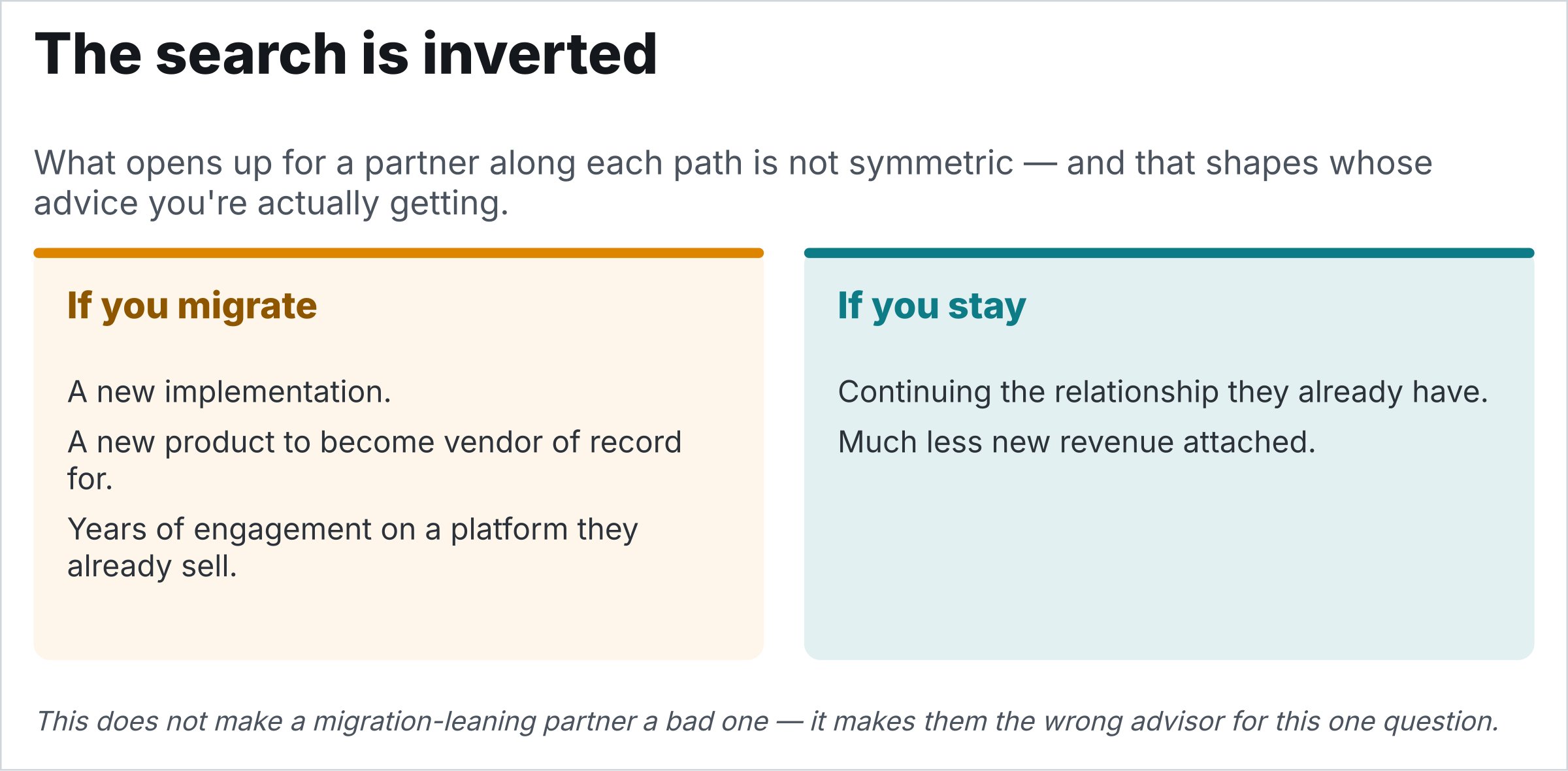
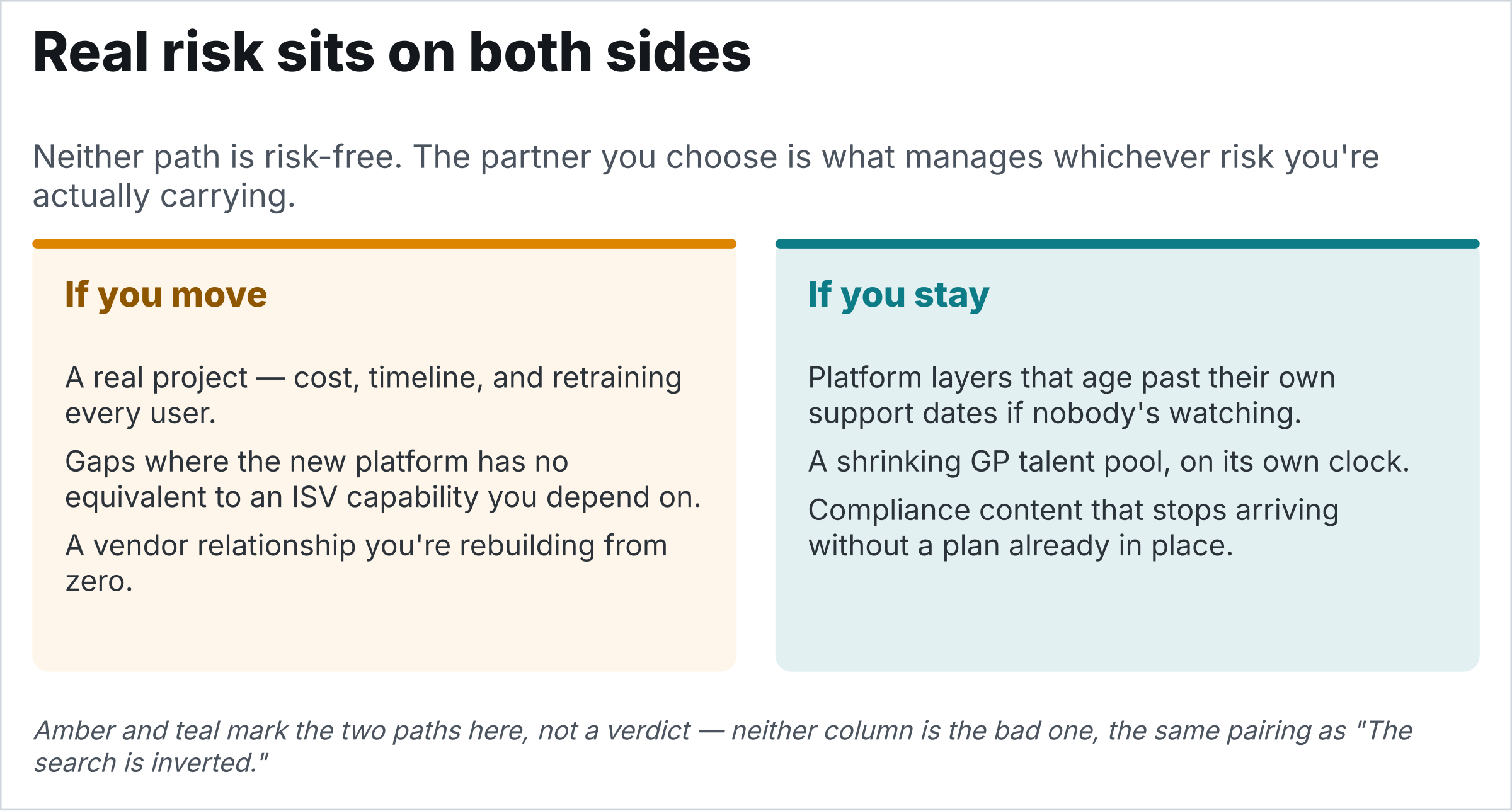
None of this is an argument that staying is the safer choice. Real risk sits on both sides, and pretending otherwise is exactly the one-sided pitch this series keeps warning against.
What You’re Actually Hiring For
Get clear on the job before the criteria, because it’s not what most partner engagements are shaped to deliver. You’re not hiring a project team for a one-time cutover — you’re hiring a relationship with three distinct parts.
The first is steady-state stewardship — the ongoing, unglamorous work of keeping the platform current underneath a stable application. It’s maintenance, not transformation, and it never ends; a firm built only for projects is the wrong shape for it. The second is knowledge insurance — the outside half of your bench, the specialist you call when a problem is past what your own team can handle, providing continuity that outlasts any single hire on your side. As the pool of people who genuinely understand GP keeps shrinking, that bench gets more valuable, not less. The third is honest counsel about the ceiling: some changes need GP’s own code changed, which only a developer with source access can do, and only where the business case is there — and some situations do warrant leaving. The partner worth keeping tells you when you’ve hit that edge, not only what you want to hear in either direction.
None of the three works without a partner who actually listens first — asking about your close, your customers, and where your own team is strong versus stretched thin, before recommending anything. The right advice for a lean five-person shop isn’t the right advice for a fifty-person multi-entity operation, and a partner pitching the same playbook to every client hasn’t done that work. Hire for the one who understands your business well enough to tell you what’s actually best for you, not what’s easiest for them to deliver.
What Separates a Good Partner From a Bad One
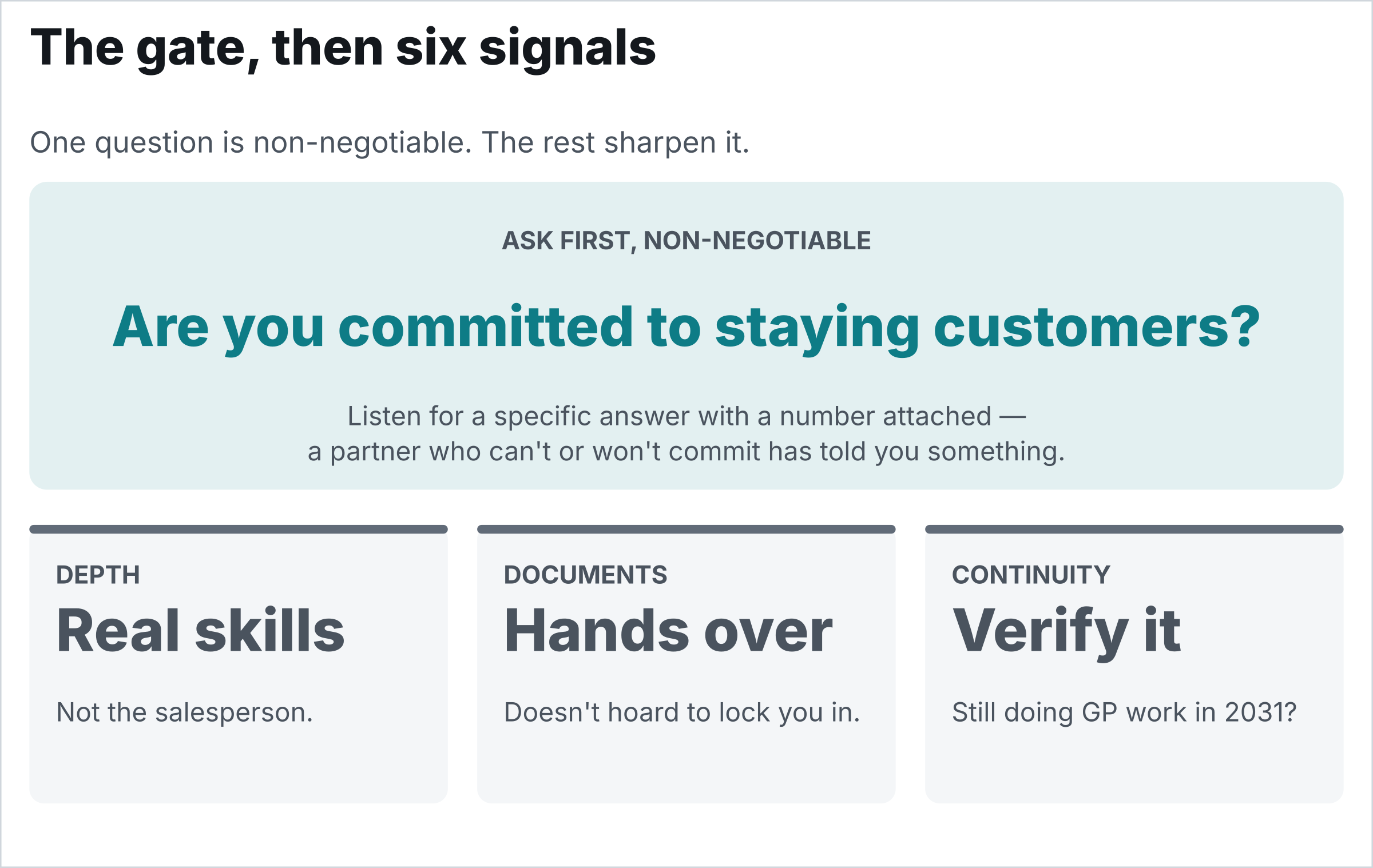
A handful of questions do most of the filtering, and the first is non-negotiable: ask directly whether the firm’s business is committed to supporting GP customers who are staying, and for how long. Listen for a specific answer, not a reassuring non-answer — a partner who can’t or won’t commit has just told you something important.
Past that gate, look for real depth in the skills getting scarce as the ecosystem’s veterans retire — probe past the salesperson to whoever would actually touch your system. I treat one thing as the clearest tell of all: whether a firm documents and hands over what it builds, or hoards it. A good partner leaves you more capable after every engagement; a bad one leaves you dependent on purpose. Look for continuity you can verify, a visible community presence, and honesty about the exit — advice that would change if your facts changed, rather than a partner who can only ever say “stay” or only ever say “migrate.” And weigh the engagement model: a retainer suits steady-state work better than a series of one-off quoted projects.
Some signals should end the conversation outright: every discussion drifting back to migration no matter where it started; a refusal to document or hand over what’s built; vagueness about the firm’s own GP practice’s future; no findable community footprint or reachable references; and a promise that a GP environment can stay “fully patched” indefinitely, which nobody can deliver once the patches stop shipping.
The good news is that this search has gotten easier, not harder, because partners committed to staying customers have stopped waiting to be found. The Knights of GP is an example: a community-led cooperative of GP users, partners, ISVs, and consultants organizing publicly around keeping the platform supported past Microsoft’s dates, with separate preferred-ISV and preferred-Partner directories as curated starting lists.
Treat a listing there, or in any similar directory, as a lead worth pursuing, not a guarantee to skip your own diligence. GP-specific conference tracks and community forums are other real starting points too. Whatever list you start from, vet the same way every time: ask for references from other shops that stayed, not shops the partner helped leave. A glowing reference from a departure tells you nothing about a firm’s skill at stewardship — you want someone this partner has kept running well for years.
The Bottom Line
Your partner isn’t a vendor to keep at arm’s length once you’ve decided to stay — they become part of the knowledge-preservation system that keeps your environment survivable when the person who understands it best is unavailable, or gone for good. That reframing settles most of the hard calls here: why intent beats price, why a willingness to document beats raw brilliance, and why the right answer to “who should we hire” is the firm that makes you less dependent, including on them.