Get More From What You Own: The Value That Doesn’t Depreciate



The migration pitch carries a quiet assumption that GP is a depreciating asset, a thing whose value only runs downhill from here. It’s a persuasive story, and it’s checkably wrong in a specific way. Most GP installations run at a fraction of what they’re licensed to do. Staying deliberately doesn’t just mean defending what you have; it means noticing how much of it you’re not using yet.
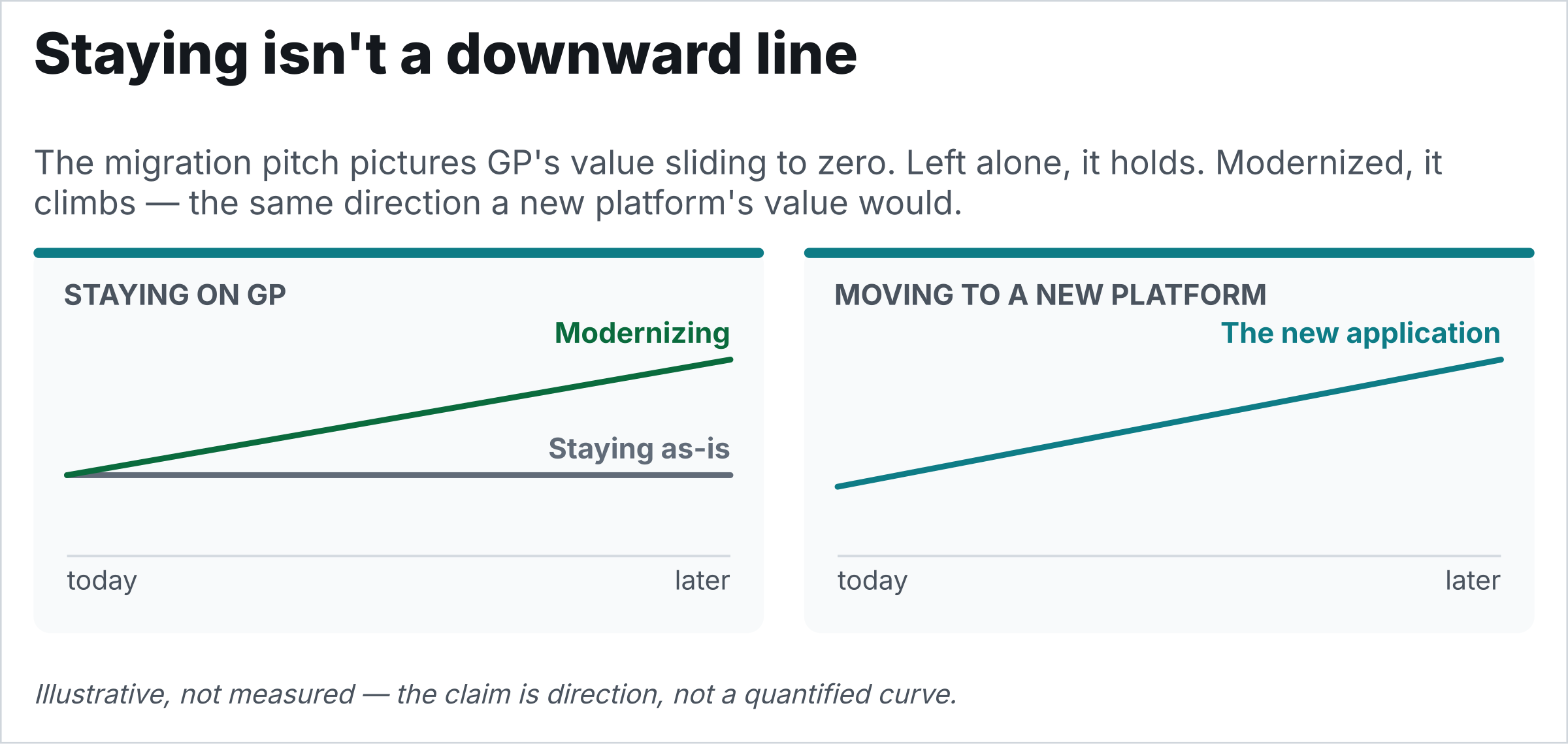
The Cheapest Modernization is the Capability You Already Paid For
Every normal modernization move costs the same things: a license, a vendor to onboard, an implementation, a training curve, and — the one that matters most past 2029 — one more piece of surface to keep working after the updates stop. Turning on a module you already own skips almost all of it. It’s already inside your GP install, already patched by the same updates, and already running on the same SQL Server.
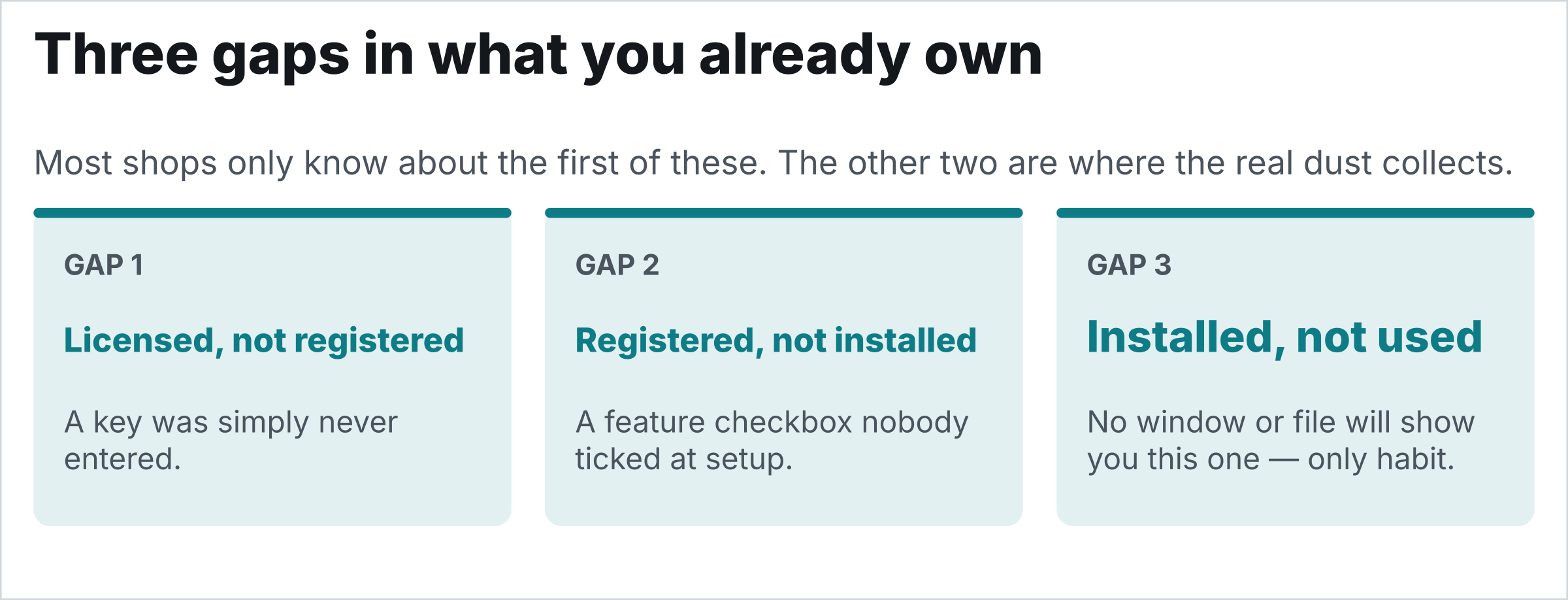
There are three separate gaps hiding in most GP systems, and most shops only know about one:
- Licensed but never registered: Your registration keys cover modules whose keys were simply never entered.
- Registered but never installed: A surprising number of the most useful modules, things like Fixed Asset Management, Analytical Accounting, and Revenue/Expense Deferrals, aren’t unlocked by a key at all; they’re separate features somebody had to deliberately choose to install, a choice often made once, years ago, and never revisited.
- Installed but never used: The gap no window or file will show you, because it lives in habit rather than configuration.
Finding the first two is an afternoon’s comparison between what your registration says you own and what’s actually installed. Closing the third is training and it’s nearly free. A shop that runs this inventory routinely finds real, displaced cost sitting idle: fixed assets tracked in a spreadsheet when a module already posts depreciation straight to the ledger, deferred revenue managed by hand when a built-in feature would recognize it on schedule, a reconciliation done manually against a statement GP could already auto-match.
None of that means switch everything on. Activation isn’t free even when the license is — every module turned on must be set up, learned, and regression-tested on every future platform change. The honest filter is three questions: Does it replace real manual work today? Does it add no meaningful new burden past 2029? And does the value clearly repay the setup cost? Fail any one and dormant is a perfectly respectable choice. Pass all three and you’ve found free value already sitting inside your own install.
The Innovation Was Always the ISVs
The pattern that founded the product never stopped. Most of what makes GP fit a specific shop instead of a generic ledger — check and payment processing, multi-entity management, advanced reporting, payroll and HR add-ons, security and administration tooling — was built by independent software vendors. Strip the ISV layer out, and what’s left is a capable but genuinely bare general ledger.
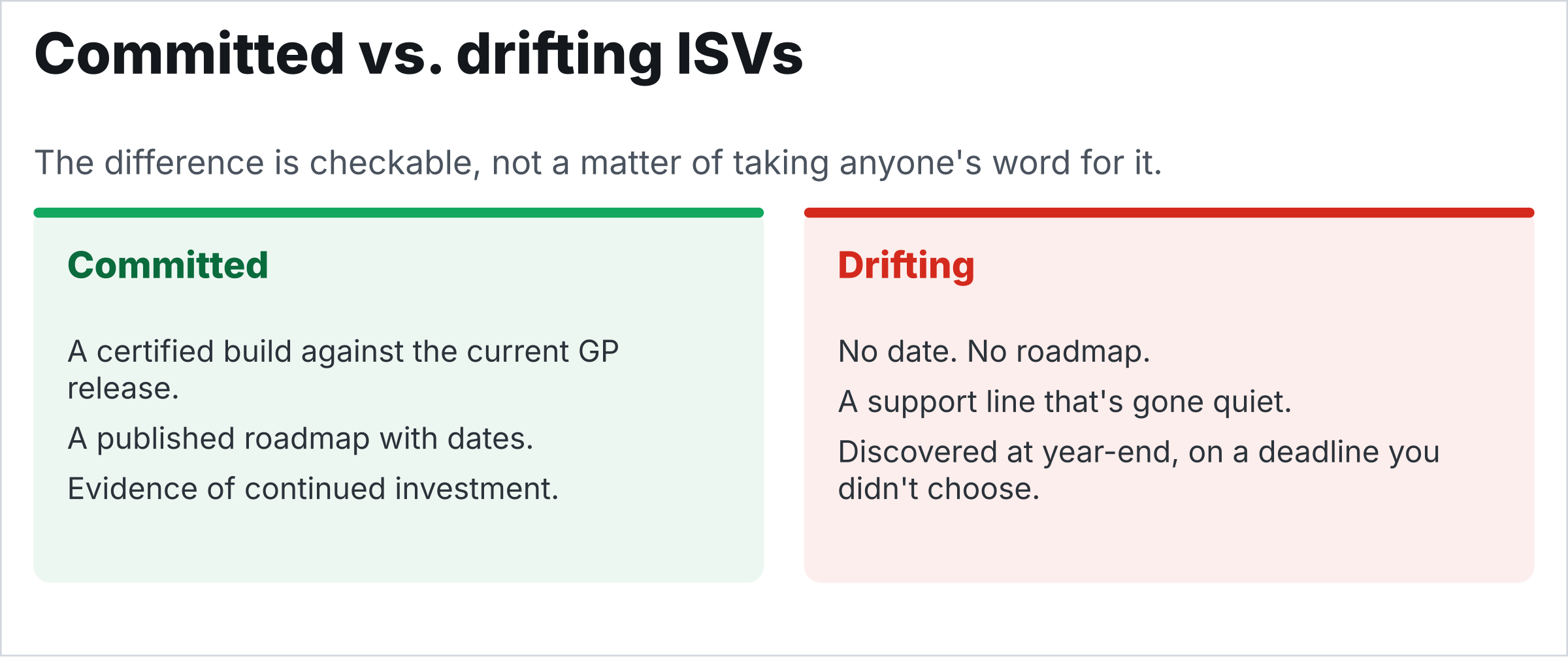
That matters more, not less, once Microsoft’s own update cadence winds down, because the burden of keeping the system current and compliant shifts decisively onto two groups: your implementation partner and the ISVs your shop actually depends on. Not every one of them is going to treat that responsibility the same way. Some have made an active, ongoing commitment to GP — still certifying against new releases, still shipping updates, still publishing a roadmap. Others have quietly shifted their energy toward newer platforms and let their GP products drift into maintenance-at-best, sometimes without saying so out loud.
The distinction is checkable, not a matter of taking anyone’s word. A committed vendor produces things with dates on them — a certified build against the current GP release, a published roadmap, evidence of continued investment. A drifting one produces an absence: no date, no roadmap, a support line gone quiet.
Formal signals have emerged to make this easier to verify from outside, including community-organized commitment pledges and a Preferred ISV designation vendors earn by committing in writing to years of continued GP investment.
The question worth asking every vendor your shop depends on isn’t “Are you committed to GP?” It’s “What have you shipped for it and when?” That’s the half of the answer nobody can phrase around.
The One Layer That Actually Gains More Valuable With Age
Everything else in this series is about holding a line — keeping the core steady, the platform current, the recovery proven. Reporting and AI are the exception. It’s worth understanding why because it inverts the usual “staying means standing still” worry.
After December 31, 2029, GP’s underlying data schema stops moving. A schema that stops moving isn’t a dead schema; it’s a stable one. For anything built to report on top of it, that stability is an advantage rather than a limitation.
Every dashboard, reporting tool, and AI assistant pointed at GP’s data through a properly governed, read-only layer is building on a foundation that will never again shift underneath it. The tooling that reads that layer keeps improving on its own schedule, independent of anything Microsoft does with GP itself. A shop that builds this layer well inherits every one of those advances for the cost of a connection, indefinitely, with no risk to the ledger, because the discipline that makes it safe is the one this series keeps returning to: It reads, but it never writes.
That’s the genuinely counterintuitive finding buried in this whole pillar. Most of what a staying shop owns holds its value by staying put. This one piece — reporting and AI, built correctly on top of frozen data — is the part of a GP investment that keeps getting more valuable the longer you stay.
The Bottom Line
None of this is a new expense or a new architecture to defend. It’s an inventory of value already purchased and largely unclaimed: modules sitting dormant that cost nothing more to switch on, an ISV ecosystem that was always where GP’s real innovation lived, and a reporting and AI layer that only gets better with time instead of worse. A shop staying on GP deliberately doesn’t just defend what it has; it goes and finds the rest of what it already paid for.