Beyond the Technology: How RSM Partnerships Are Driving Enterprise Transformation

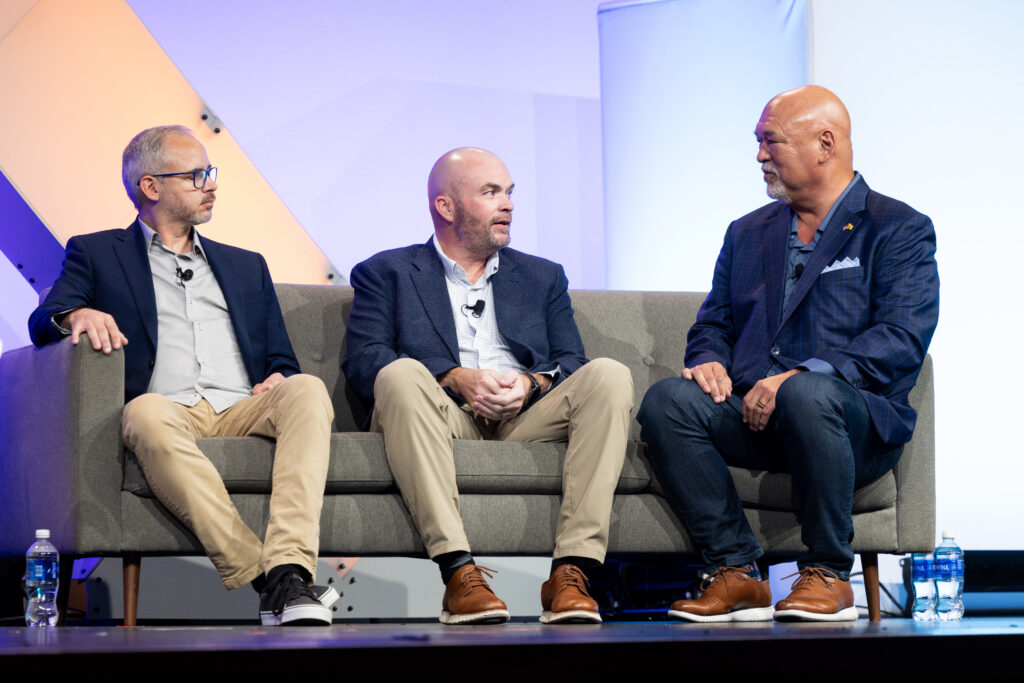
RSM’s VIP Frontier Customer Day at Community Summit NA was all about customer impact. To support that focus, a range of customers took to the stage to share their stories.
Ryan Fritts, CIO at Everon, and Nick Peterson, Senior Advisor and FieldPRO Program Manager at Phillips 66, joined Mike Gillis, Owner and Principal at RSM, and John Siefert, CEO of Dynamic Communities and Cloud Wars, to discuss the customer journey.
Gillis explained how RSM deliberately began its Frontier journey by being “customer zero”. As RSM improved its own processes and solutions, it was able to share those learnings with customers.
Moving beyond these opening remarks, Fritts explained why aligning business strategy and processes is critical. At Everon, a leading provider of commercial security, video, fire, sprinkler and life safety solutions, seconds really matter, and every decision can be critical. “A bad day can mean a really bad day for somebody else,” said Fritts.
In light of this, the motivation for deploying automation and AI at Everon is not always cost-related. Often, it’s about consistency and speed.
Turning to Phillips 66, Peterson explained how the company is involved in producing and delivering essential energy products, including jet fuel, gasoline, and diesel. He described working with RSM as an amazing experience that had helped connect the dots along the way. Without that partnership, they would still be at the very beginning of the project.
Helping Organizations Navigate Change
Siefert asked Gillis how RSM helps organizations navigate change. “Organizations need to get the fundamentals right, particularly their data and how they approach change,” he said.
Gillis explained that, historically, change management had been a relatively small part of the conversation. Today, it is far more important.
In fact, change management is now part of almost every conversation.
Fritts discussed how change is something you are either affecting or being affected by. How people internalize change, he said, depends on organizational structures and how teams communicate. In his experience, misaligned communication is often where things go wrong.
Innovation in Action
In a separate session, the audience heard from two more customers: Nathalie Pougno, Vice President of Information Technology at Ramudden Global North America, and Jerud Colbert, Business Solutions Architect at the State of Tennessee. The session was led by Pam Bowden, Managing Director of Business Applications at RSM.
Ramudden is a global company operating in 14 countries, with more than 5,000 employees. As the organization embarked on its transformation journey, the key question was how technology could move as quickly as the business.
The team carried out comprehensive assessments, taking the time to review its existing applications. The process ultimately led to the selection of Microsoft Dynamics 365 Business Central.
Pougno described the transformation as a partnership built around four key pillars: the business, IT, RSM and Microsoft. Monthly committee meetings helped the teams work closely together.
The transformation also became a cultural change within the company. It became something people wanted to be involved in, and the organization is now looking to invest further and prioritize additional improvements.
State-Level Transformation
During his segment, Colbert was joined on stage by John Corroto, Partner and State & Local Government Microsoft Practice Leader at RSM, with whom he has worked closely.
Colbert explained that state agencies operate very differently from the private sector, where he had previously worked. Tennessee has a mix of vendors and systems provided by different agencies, alongside homegrown citizen-development solutions. This means the state inherits and manages a range of disparate systems rather than operating within a single, unified environment.
For example, one Tennessee environmental agency had separate operations across 19 divisions, all using the same invoicing system. The agency wanted to consolidate numerous applications, but there was no clear roadmap. When the team began evaluating platforms, Corroto encouraged Colbert to explore building a system that the state could support.
The solution also needed to comply with the state’s IT governance guidelines, and around 200 applications needed to be consolidated.
Microsoft Power Platform, including Power Automate, has made this and many other processes much easier.
Corroto closed the discussion by emphasizing that the relationship was a true partnership. RSM was never treated simply as a vendor. Over the past five years, the team was held accountable for its work, helping ensure that solutions were built and technology was used in ways that supported the state’s objectives.
This sentiment really flowed through all of the partner discussions. RSM entered into true partnerships, where co-creation, mutual understanding, and at times, even debates that needed to be worked out, led to the best possible outcomes for customers.