Beyond Unified Service Desk: What the End of USD means for 3-1-1 and Municipalities

By Robert Bailey, Upzoids
As of April 1, 2026, Microsoft has officially deprecated Unified Service Desk for Dynamics 365 Online, signaling the end of active investment in the platform. While USD remains technically supported for a limited time, the strategic direction is clear: USD belongs to the past, and modern contact centers must move forward. [microsoft.com]
But this transition isn’t just about swapping one agent desktop for another. It’s about rethinking how service is delivered in a world shaped by omnichannel engagement, AI‑assisted agents, and rising citizen and customer expectations.
USD Served Its Purpose; But It Was Built for Another Era
Unified Service Desk was, in many ways, ahead of its time. It brought together multiple systems, reduced swivel‑chair operations, and enabled highly customized agent experiences. For years, it powered mission‑critical environments, particularly in complex public sector and regulated scenarios.
However, USD was fundamentally designed for:
- Single‑channel, agent‑centric workflows
- Heavy desktop customization
- On‑premises and early cloud architectures
As Microsoft evolved Dynamics 365 into a cloud‑first, evergreen platform, USD became increasingly misaligned with where customer service was heading. Microsoft’s own guidance now reflects this reality. New capabilities such as multi‑session workspaces, native omnichannel, Copilot, and autonomous agents are not available in USD and will never be back‑ported
The Official Timeline: Where We Are Now
To put things in context, Microsoft has published a clear set of milestones:
- April 1, 2026 – USD deprecated; no further investment
- April 30, 2027 – End of service; no quality or security updates
- June 30, 2028 – End of support; USD taken out of service entirely [microsoft.com]
For organizations still running USD today, this isn’t an abstract future risk—it’s an active modernization window.
Customer Service Workspace Is Not “USD Rewritten”
Microsoft’s recommended successor, Dynamics 365 Customer Service workspace, represents a fundamentally different philosophy.
Rather than a highly scripted desktop container, Customer Service workspace is:
- Model‑driven and cloud‑native
- Designed for true omnichannel engagement
- Continuously enhanced with AI and Copilot capabilities
Key differences include:
- Multi‑session case handling across channels
- Native integration with digital messaging, voice, and knowledge
- Embedded agent assistance and summarization via Copilot
- A UI and extensibility model aligned with the broader Power Platform
For many teams, this shift is less about feature parity and more about letting go of legacy customization patterns that no longer scale.
Why This Matters Even More for Municipal and Public Sector Teams
In municipal environments – particularly 311 and citizen service operations – the limitations of legacy contact center models are felt acutely.
Cities are expected to:
- Support multiple channels (phone, web, chat, email)
- Provide transparent, trackable service outcomes
- Integrate with GIS, asset systems, and line‑of‑business platforms
- Do more with flat or shrinking budgets
USD‑style architectures struggle under these pressures. They require ongoing maintenance, deep technical expertise, and custom code that becomes brittle as platforms evolve.
Modern contact centers, by contrast, emphasize:
- Configuration over customization
- Shared data models across departments
- Self‑service and deflection alongside agent support
- Incremental improvement rather than big‑bang rewrites
What we at Upzoids have Learned Modernizing 311 and Contact Centers
Across municipal projects, a consistent pattern emerges: the real challenge is operational transformation.
i.e. Successful transitions focus on:
- Simplifying service request discovery and intake
- Standardizing case and workflow patterns
- Enabling agents with better context, not more screens
- Designing citizen experiences that reduce avoidable contact
This is where modern Dynamics 365 capabilities can dramatically reduce risk and time to value.
Where UpCITY 365 Fits Into the Conversation
At Upzoids, our work on UpCITY 365 grew directly out of these realities.
Rather than treating municipal contact centers as generic customer service environments, UpCITY 365 extends Dynamics 365 Customer Service with:
- Pre‑configured 311 service models
- Smart request discovery and dynamic routing
- GIS‑aware service visualization
- Citizen self‑service built on Power Pages
- Alignment with Microsoft’s evergreen roadmap [upzoids.com]
The intent isn’t to replace Microsoft’s platform, but to remove the need for cities to reinvent the same patterns repeatedly as they move away from legacy approaches like USD.
Importantly, this approach aligns with Microsoft’s broader shift toward composable, low‑code, and AI‑assisted service delivery, rather than monolithic, heavily customized desktops.
AI Changes the Stakes Entirely
One of the most significant differences between the USD era and today is the arrival of practical, embedded AI. These capabilities are native to modern Dynamics 365 contact center experiences and simply do not exist in USD:
- Case and conversation summarization
- Knowledge suggestions
- Automated service discovery
- Digital agents handling routine requests
This Is a Strategic Reset
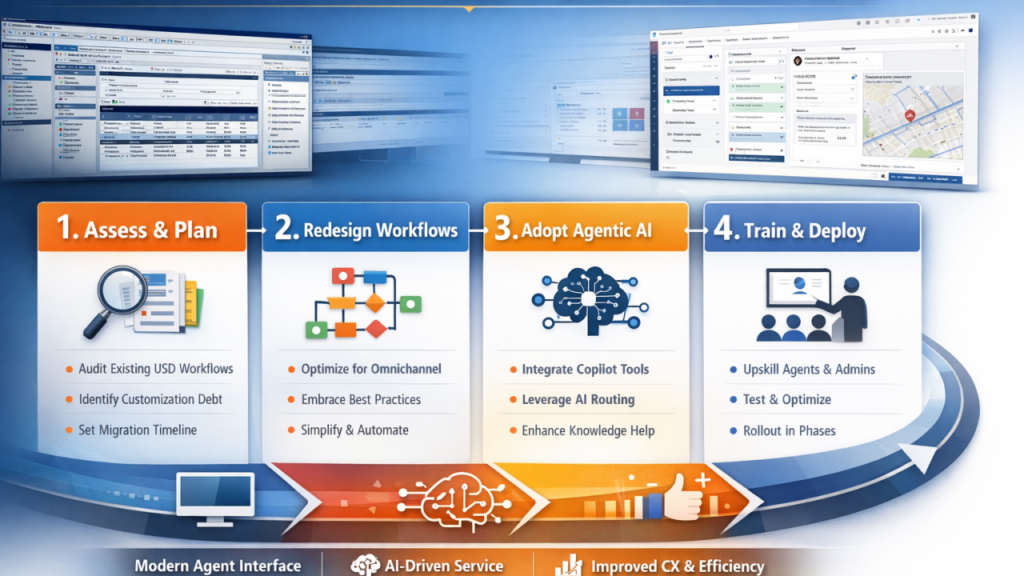
The end of Unified Service Desk is a reflection of how dramatically service expectations and enabling technologies have changed. Organizations that treat this moment as a forced upgrade risk recreating yesterday’s problems on today’s tools. On the other hand, those that treat it as a strategic reset – rethinking processes, channels, and citizen experiences – are far better positioned for what comes next.
Final Thought
USD helped a generation of organizations professionalize their contact centers. But the future belongs to platforms that are cloud‑first, AI‑assisted, and designed for continuous evolution.
The question is no longer if you move on from USD, but how intentionally you do it.