


AX 2012 Job Registration History Time vs. Start/End Times

  • AX 2012 Job Registration History Time vs. Start/End Times
    Posted by DSC Communities on May 15, 2017 at 9:48 pm
    • Jim Czerniak

      Member

      May 15, 2017 at 9:48 PM

      Hi AXUG,

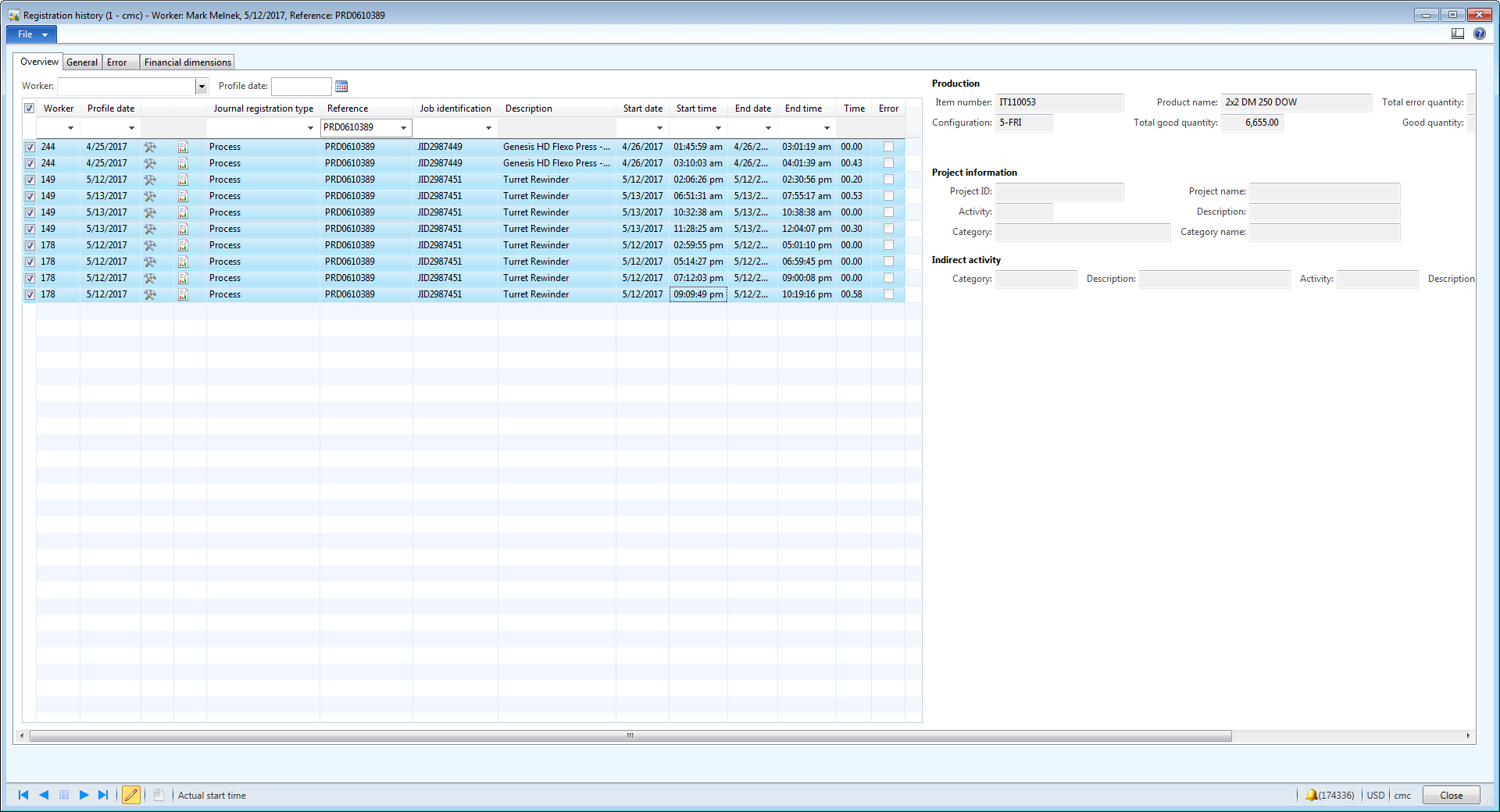
      We have AX 2012 Feature Pack and I am seeing that in some instances when I look at the registration history in (Production Control –> Inquiries –> Registrations –> Registration History) that the value in the “Time” column does not match the difference between the Start Date/Time and the End Date/Time. Ā See below. Ā In some cases the “Time” column is showing 00.00 when there is over an hour difference between the Start Date/Time and End Date/Time. Ā In other cases, the “Time” column is showing a value like .30 hours when the difference between the Start Date/Time and End Date/Time is over .5 hours. Ā  Shouldn’t these match? Ā When I look at the data from a broader scope I can see that in many cases they do match. Ā However, these is also many times that they don’t. Ā What am I missing? Ā Any thoughts?

      YVHac52S6sqQu0QMuieQ_RegistrationHistory.png

      ——————————
      Jim Czerniak
      Applications Developer
      CMC Group
      Bowling Green OH
      ——————————

    • Robert Stogner

      Member

      May 16, 2017 at 8:28 AM

      Is it possible that they are using Job Bundling?Ā  Where they are working on two or more jobs at the same time?Ā  If so, then the time applied to each job while they are working on those jobs concurrently will be split evenly.Ā  So the applied hours will not match the start and end time difference.

      ——————————
      Robert Stogner
      I.B.I.S. Inc., a Sonata Company
      Burlington NC
      ——————————
      ——————————————-

    • Jim Czerniak

      Member

      May 16, 2017 at 9:38 AM

      It’s possible that they are using Job Bundling, but is there a way that I could definitively see that? Ā Also, I’m not sure then, even if they are using Job Bundling, how the 0.00’s can be explained since some show 0.00. Ā Any thoughts?

      Thanks for your help,

      ——————————
      Jim Czerniak
      Applications Developer
      CMC Group
      Bowling Green OH
      ——————————
      ——————————————-

    • Robert Stogner

      Member

      May 17, 2017 at 8:08 AM

      Well the screen you show is filtered on production order, try to review based on a particular date (a date where there seems to be an issue) and look at all workers, all jobs for that date and then see if there are any overlaps of workers per job, etc.

      ——————————
      Robert Stogner
      I.B.I.S. Inc., a Sonata Company
      Burlington NC
      ——————————
      ——————————————-

    • Jim Czerniak

      Member

      May 24, 2017 at 8:26 AM

      After reviewing a bunch of the logs, I was finally able to figure out what was happening with this. First I figured out that there were only 3 users that were having this issue. Ā  Ā What I found was that for each of these 3 users they had a record in the JMGTERMREG table for their worker that was Active with a REGTYPE of “JMGTERMREGTYPE::JOBSTART. Ā Now this particular record was from sometime last year, and had no corresponding record in JMGJOBTABLE if I tried to join on JOBID. Ā  It seems like since this orphan record was Active and in a JobStart status, it was treating kind of like bundling, so that every time they stopped/completed a job it would half the time. Ā Once I cleared the record for each of these users, the time started reporting correctly.

      Still not sure how this happened.

      ——————————
      Jim Czerniak
      Applications Developer
      CMC Group
      Bowling Green OH
      ——————————
      ——————————————-

    DSC Communities replied 8 years, 10 months ago 1 Member · 0 Replies
  • 0 Replies

Sorry, there were no replies found.

The discussion ‘AX 2012 Job Registration History Time vs. Start/End Times’ is closed to new replies.

Start of Discussion
0 of 0 replies June 2018
Now

Welcome to our new site!

Here you will find a wealth of information created for peopleĀ  that are on a mission to redefine business models with cloud techinologies, AI, automation, low code / no code applications, data, security & more to compete in the Acceleration Economy!