
Dynamics Business Central (NAV)
Public Group
Active 5 days ago
Experts:




Changing the Relational Exchange Rate Amount on a Purchase Invoice
-
Changing the Relational Exchange Rate Amount on a Purchase Invoice
Posted by Lewis Rosenberg on March 28, 2017 at 10:00 am-
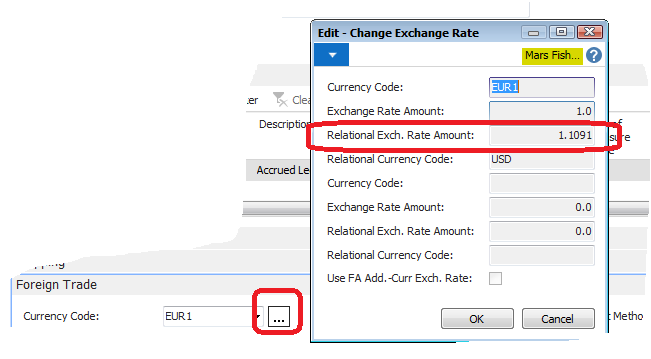
We noticed that sometimes we can change the Relational Exch. Rate Amount on a Purchase Invoice and sometimes we cannot.
 erg
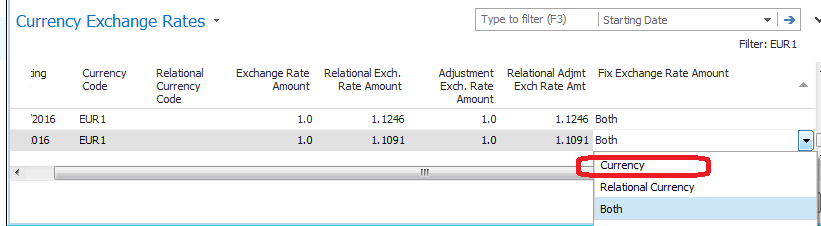
ergIt appears that when the Fix Exchange Rate Amount is set to Currency in the Currency Exchange Rate setup, we can make the change, but when set to Both we cannot.
Can anyone explain how this is suppose to work?
——————————
Lewis Rosenberg
IT Manager
Mars Fishcare
Chalfont PANAVUG Board of Advisors, Programming
NAVUG Programming Committee
NAVUG Membership Committee
—————————— -

Thomas (Tom) Blaisdell
MemberMarch 28, 2017 at 10:43 AM
Good morning Lewis,
Thank you for posting on the Forum. Normally, you would never set the option to ‘Both’ because you need the ability to modify and enter a “spot rate” for the transaction.
The option for Both goes back to when the EURO countries originally adopted the EURO in lieu of the Local country currency from my recollection. For a transition period, the EURO conversion for adopting countries was fixed, so there was as a set, fixed Exchange Rate for say German/Deutsche Mark to EURO, French Franc to EURO, etc. The option was set to “Both” during the transition to fully move to EURO. Currency translation during the transition period involved ‘currency triangulation’, where the adopting European Countries currencies converted from the Local Currency adopting the EURO to/from the EURO at a fixed exchange rate. Thus, the option for “Both” had to be used during the transition. During that time of transition, the EURO was then converted to whatever the other currency was with a fluctuating currency exchange rate to that other (non-EURO) Currency. The term “triangulation” was used during the transition because currency exchange during the transition involved first converting to/from EURO from/to the (German Marc, French Franc, etc.), and then to any other currency outside of the EURO countries’ currencies during the transition. This happened back in the late 90’s and early 2000’s, if I recall correctly. See link below for further information.
About the euro Triangulation ConversionTherefore, as you have found, you don’t want to set the option to Both unless you want to lock the exchange rate. It is a carry-over feature from back in the original adoption of the EURO. The feature was not ever removed because the expectation is that there could be a particular country that locks the exchange rates, so the option is there to do that. However, in most financial transactions and processing, a company would typically not lock the exchange rates but need to be able to modify the exchange rate on a transactional basis.
I hope this helps.
Best Regards,
——————————
Tom Blaisdell
Sr. Support Escalation Engineer
Microsoft
Alpharetta GA
——————————
——————————————- -
Oh Wow! Thank you so much, Tom. That definitely helps.
It is great to see you here and I hope to see you in October.——————————
Lewis Rosenberg
IT Manager
Mars Fishcare
Chalfont PANAVUG Board of Advisors, Programming
NAVUG Programming Committee
NAVUG Membership Committee
——————————
——————————————-
Lewis Rosenberg replied 9 years, 6 months ago 1 Member · 0 Replies -
-
0 Replies
Sorry, there were no replies found.
The discussion ‘Changing the Relational Exchange Rate Amount on a Purchase Invoice’ is closed to new replies.