Governing the Platform Under Your CRM: Power Platform Governance for D365 Customer Engagement

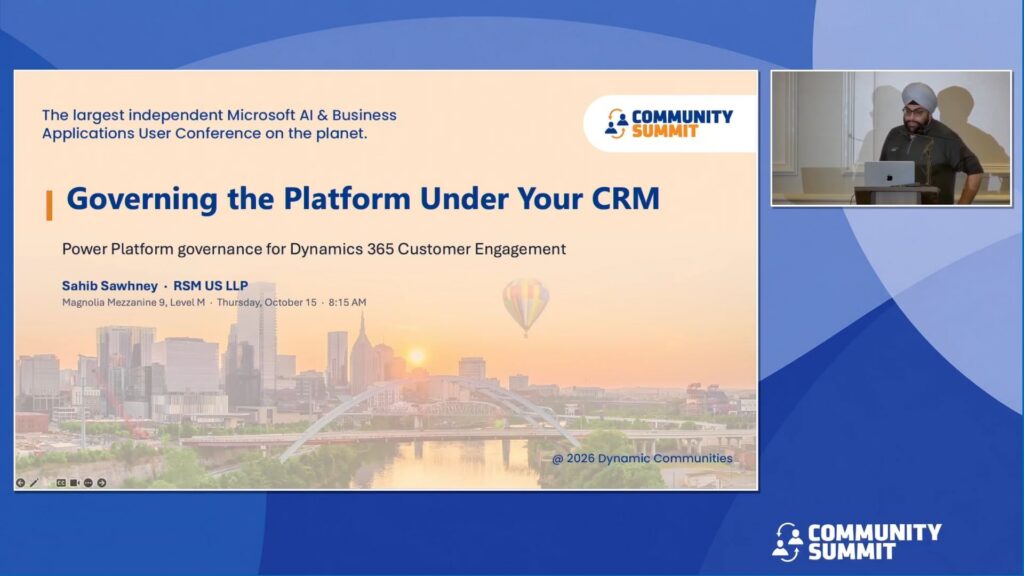
Session Overview: Your D365 Customer Engagement environment does not exist in a vacuum. It sits on top of Power Platform, which means every Sales workflow, every Customer Service automation, every Copilot Studio agent, and every custom Power App built by your team is subject to a governance layer that most CE teams did not set up and many do not fully understand.
Here is what happens when governance is an afterthought: a well-intentioned sales ops team builds a Power Automate flow that pushes lead data to a third-party enrichment service through an HTTP connector. A customer service manager creates a Copilot Studio agent that can query case records but accidentally exposes it to unauthenticated external users. A marketing analyst exports a Customer Insights segment to a personal OneDrive. None of these people did anything malicious. They just operated in an environment where the guardrails were not in place.
This session is a complete governance walkthrough built around CE-specific scenarios. We will start at the environment strategy level – why your production CE environment needs Managed Environments enabled, how to structure dev/test/prod with proper solution transport, and the security group boundaries that prevent cross-environment data leakage. From there we will get into DLP policies and how they specifically affect CE workloads: which connectors your Sales and Customer Service teams actually need, how to classify business vs. non-business connectors without breaking legitimate automations, and the connector granularity controls that let you block specific actions within a connector rather than the entire connector.
We will cover the Power Platform Center of Excellence (CoE) Starter Kit in detail – not just what it is, but how to use it to answer the questions your leadership is asking: Who is building what? How many apps and flows exist across our environments? Which ones are connected to our CE data? What is our license utilization? We will walk through the setup, the governance components, and the compliance and audit capabilities that give you visibility into your tenant.
We will also address the newer governance surfaces that CE teams need to care about: Managed Environments for maker onboarding and sharing limits, Copilot Studio agent publishing controls, environment routing for new agents and apps, and how generative AI feature toggles affect what your CE agents can and cannot do. If you are responsible for a D365 CE deployment and someone asks you “is our platform governed?” – after this session, you will be able to answer confidently.
Learning Objectives:
- Design and implement an environment strategy with Managed Environments, security groups, and DLP policies tailored to D365 Customer Engagement workloads across Sales, Customer Service, and Marketing.
- Deploy and operationalize the Power Platform CoE Starter Kit to gain visibility into app and flow inventory, license utilization, and maker activity across your CE tenant.
- Configure governance controls for AI-powered CE scenarios, including Copilot Studio agent publishing restrictions, generative AI feature toggles, and connector-level action controls that protect customer data without blocking legitimate automation.
Speakers: Sahib Sawhney, Duke DeVan
Recorded at: Community Summit NA 2026
Type: Education Session
Ability Level: 201 – Intermediate
Primary Product: Dynamics 365 CE (CRM)
Tracks: Technical (Systems Admin), Data
Terms: All rights reserved by the speaker, Community Summit NA, and Dynamic Communities and cannot be reproduced or distributed without express written consent by the speaker and Dynamic Communities.