
Can anyone please help me revisit why the “Document Date” on a purchase invoice is replaced by the “Posting Date”? For us – the “Document Date” is the vendor invoice date on which the payment terms are applied and the “Due Date” calculated. We have an approvals system however; and the invoice is not posted until the final approval has been obtained – at which time the “Posting Date” is edited to reflect the date the purchase invoice is actually posted to the ledgers in NAV. When the “Posting Date” is changed however; the “Document Date” is also changed to the value in the “Posting Date” field and the “Due Date” is automatically recalculated. The “Document Date” then needs to be manually edited back to the original static vendor invoice date – very annoying. Can anyone please provide some insight as to why NAV works in this way?
—————————— ES Barrett NAV Project Manager Sudbury ——————————
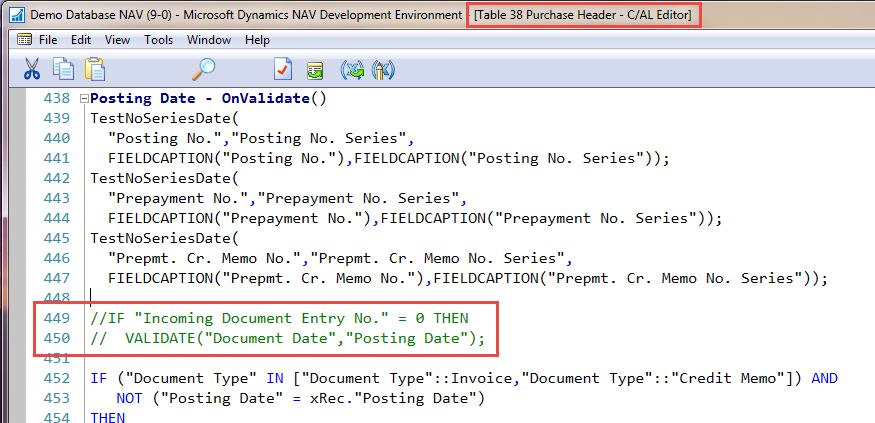
There is a line of code in table 38 (Purchase Header) which sets the Document Date to the Posting Date whenever the Posting Date is changed but only if there are no Incoming Documents attached to the order.Ā If there is at least one Incoming Document Entry assigned to the invoice, you can change the posting date and it will not change the document date.
Now the problem is that not too many companies use the Incoming Document feature.Ā Because of this, you should have your partner (or you can do it if you have access to the C/AL code) comment out the line in the code which tests for this.Ā The lines in question are shown below (shown already commented out).Ā Please remember to test this beforehand.
—————————— Dave Wiser Controller Beckwith & Kuffel Seattle WA —————————— ——————————————-
Please note:
This action will also remove this member from your connections and send a report to the site admin.
Please allow a few minutes for this process to complete.
Report
You have already reported this .
Welcome to our new site!
Here you will find a wealth of information created for peopleĀ that are on a mission to redefine business models with cloud techinologies, AI, automation, low code / no code applications, data, security & more to compete in the Acceleration Economy!