

Dynamics Business Central (NAV)
Public Group
Active 2 weeks ago
Experts:




Issue with Assembly order GL postings
-
Issue with Assembly order GL postings
Posted by Michael-Carr on August 8, 2017 at 10:56 am-
We are on 2013R2 release 7.1.36703.0. We use exclusively standard cost and process work exclusively as assembly orders.
Our release is pretty old but we are planning on upgrading in 4th Qtr.
I am digging into costing after 2 1/2 years at this level and it appears to me that we had out General posting group laid out incorrectly and had out WIP account listed in the Inventory Adjustment Account in the the General Posting Group. This was causing our revaluation variance to end up in WIP ———–creating an imbalance. So I thought “oh got the wrong account ” in the posting table so I changed it to the Revaluation account. Immediately the WIP entries began to appear in the revaluation GL account? Huh?
Switched it back but — shouldn’t the consumption and output on assembly orders be using nothing more the the Inventory posting Group on the part and the Inventory posting table to determine where to post assembly order transactions?
This looks like a “bug” to me —- has anyone else encountered this and has Microsoft fixed it in subsequent releases?
Thank for the sharing of any knowledge.
——————————
Michael Carr
VP , Finance
Philadelphia Scientific LLC
Montgomeryville PA
—————————— -

Ian Ray
MemberAugust 8, 2017 at 11:53 AM
Olof Simren posted a fairly detailed explanation of Assembly Order Posting to General Ledger.This may be helpful, especially this part
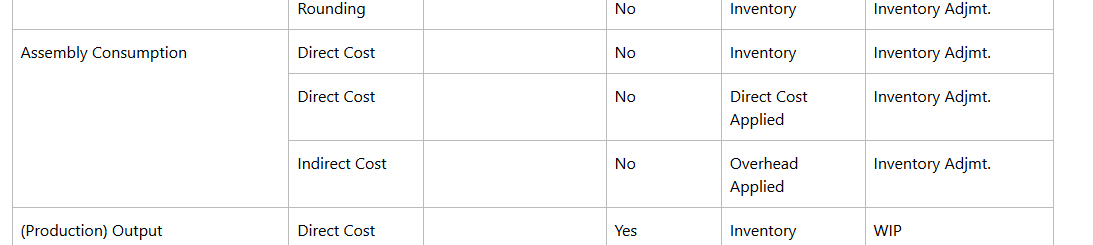
For the output; NAV debits the inventory account in the balance sheet and credit the inventory adjustment account in the P&L. The amount is the sum of the posted inventory and resource costs. If the item is a standard cost item (like in our case) you might also get some variances posted into the P&L (if there is a difference between the standard and actual costs). The variance accounts comes from the inventory posting setup for the posting group defined on the assembly item and the balancing account for the variances is the inventory account (which makes the inventory value in the balance sheet match the standard cost).——————————
Ian Ray
Cypress Grove
Arcata CA
——————————
——————————————- -
Thanks , Ian.
I just have an issue everything and the kitchen sink being dropped into a single account the P&L.
If I pull inventory from RM and create an assembly or a sub assembly and place it back as a sub assembly or Finished good it should 1. Be classified as an inventory clearing. 2.Shouldn’t be going to the same account as a revaluation posting as it loses the clearing account function and it is such a disparate function for revaluation , cycle counts, and lost or scrapped inventory ? No , you should be looking to the Inventory Posting group setup for a balance sheet inventory account.
I know it’s an assembly meant for limited ………. but the entire logic appears faulty ,…….. no actually is faulty.
I read Olaf’s blog which is good at describing the process but I stll will end up up with a shepherds pie of a General Ledger account – impossible to reconcile or effectively describe what the meaning of the account balances are with mixing all of them .mixing all of the above. I will take for your response that it will continue into the future so I will have to customize it and ( to really kill a Ian-ism from an earlier post) set up a user column in the Inventory Posting group and have the posting routine use that account.
Thanks for your response , accurate and informative as always.
——————————
Michael Carr
VP , Finance
Philadelphia Scientific LLC
Montgomeryville PA
——————————
——————————————- -
Ian Ray
MemberAugust 8, 2017 at 4:16 PM
If it is at all helpful…Assembly orders do not have any work-in-process step. If you navigate G/L entries on a posted assembly order without resources, you can see it is all just inventory and inventory adjustment.
If we are strictly talking about inventoried items, we could replicate the G/L activity of an assembly order by posting an item journal. In fact, if just looking at G/L account no. and amount columns, an item journal and an item-only assembly order are indistinguishable (if they use the same cost values).
In contrast, production orders debit a NAV WIP account for all of the inventory cost incurred during production. The same WIP account is credited based on completed goods output. If you navigate G/L entries on a posted production order, you can see everything flows through the specified WIP account.
——————————
Ian Ray
Cypress Grove
Arcata CA
——————————
——————————————- -
Ian,
I understand and that’s a great explanation
In fact , if not in NAV nomenclature, it does post WIP. but it uses the Inventory Adjustment account in the General Posting Table to record inventory movement. It shouldn’t. As you say the actual physical Movement is out of Raw or Semi Assembled to an invisible operation back to Semi Assembled or Finished goods. What’s the actual difference between goods movement in a ProdO or an AO? Neither is a P&L item. Burt NAV just throws them together.
The design should be looking to the IPG and the Inventory Posting table for a clearing account , preferably in the balance sheet.
We are in agreement on how it works ———- I think from accounting and financial perspective NAV shortcut this design badly.
——————————
Michael Carr
VP , Finance
Philadelphia Scientific LLC
Montgomeryville PA
——————————
——————————————- -
OMG ——-It’s designed this way …….( sounds of head pounding against desk)…………. please tell me they modified it by 2017!
Has anybody got any work arounds?
I can use GPPG on Manual inventory adjustments as a work around already but not on the revaluation Journal ——- or do I have to pay a VAR for a customization due to lack of Accounting Knowledge on Microsoft’s part <GRIN>?
——————————
Michael Carr
VP , Finance
Philadelphia Scientific LLC
Montgomeryville PA
——————————
——————————————- -
Kevin Fons
MemberAugust 9, 2017 at 9:04 AM
Assembly orders were originally called Kitting and Ian is correct they have very basic functionality.
They were originally meant for cases where you might go pull 2 items off the shelf in shipping that create a “kit” and ship to the customer.
They will only back-flush material. Components come out and finished item goes in, no WIP, clearing, etc.The components remain in inventory until the order is finished which can be a long time for an Assemble to Order item that is not finished until the Sales Order posts.
It sounds like you would be better served with Production Orders which allow many more options for the G/L transactions. Production Orders are not that complicated and have quite a bit of additional functionality and flexibility.
Kevin
——————————
Kevin Fons
Senior Application Consultant
Innovia Consulting
Windsor WI
——————————
——————————————- -
I understand that Ian is correct. But it does not just come out of RM and go to FG. The accounting is treated the same as Production Orders.
This is the posting ( assuming no labor posting) for Posted Assembly orders:
Dr Clearing Account
Cr Raw material
Cr Clearing Account
Dr. Finished GoodsTreatment of Production Orders:
Dr WIP
Cr Raw material
Cr WIP
Dr. Finished GoodsBut instead of using the Inventory posting table and assigning a clearing account ( either WIP or a new column which makes more sense) – it goes to the General Posting Table and chooses the Inventory adjustment table and dumps a clearing account transactions on top of all the physical adjustments, cycle counts, revaluation entries, etc creating a mess of an account to analyze.
The design is very poorly done and inconsistent with how NAV treats other inventory movements. I was hoping that the design might be changed by NAV2017 but I guess not. It should be but unless somebody points it out……
Thanks for your response and the opportunity to clarify my point.
——————————
Michael Carr
VP , Finance
Philadelphia Scientific LLC
Montgomeryville PA
——————————
——————————————- -
John Grant
MemberAugust 11, 2017 at 10:45 AM
Michael – you are spot on how Assembly Orders Post and are not consistent with manufacturing postings. The major difference in posting I suspect is that you can purchase NAV without manufacturing functionality. Meaning a distributor would not need a WIP number but simply the functionality to “kit” products and post accordingly – not that my reason helps a manufacturer who uses Assembly Orders and is looking for consistent functionality.Best Regards
——————————
John Grant
Senior Application Consultant
Innovia Consulting
——————————
——————————————-
Michael-Carr replied 9 years ago 1 Member · 0 Replies -
-
0 Replies
Sorry, there were no replies found.
The discussion ‘Issue with Assembly order GL postings’ is closed to new replies.