
Direct Cost applied accounts in Manufacturing companies

  • Direct Cost applied accounts in Manufacturing companies

    Posted by Djon Darko on March 25, 2026 at 5:28 pm

    I am having difficulty explaining the concept of Direct cost applied accounts to a client in a manufacturing company. Their thought process is that because they are offset/contra accounts, they should clear out in the chart of accounts.

    For example, with labour consumption

    Debit WIP

    Credit DCA

    When does the DCA account get cleared out or never? Is it a case that when the finished good is sold and COGS is then populated that it offsets the DCA for Labour?

    Similar with materials – how does this clear down? Or does it clear down automatically by the below posting?

    Debit WIP

    Credit DCA

    Debit DCA

    Credit Raw materials

    Ian Ray replied 1 week ago 4 Members · 4 Replies
  • 4 Replies
  • Hardik Gupta

    Member
    March 26, 2026 at 6:23 am
    Up
    0
    Down
    ::

    Hi Djon,

    DCA accounts are NOT meant to zero out. They’re throughput accounts, not traditional contra accounts.

    When you post labour or materials, BC routes the cost through DCA into WIP. The WIP account is what eventually clears when the finished good is sold and COGS gets hit. DCA just reflects cumulative direct costs that flowed through production.

    At period end, your DCA balance should mirror what’s sitting in WIP/COGS on the other side. That’s your reconciliation check.

    If your team wants a deeper walkthrough on the full cost flow from raw material to COGS in BC, we’re happy to help. Sometimes one focused session clears up months of confusion!

  • Steven Chinsky MVP

    Moderator
    April 1, 2026 at 9:03 am
    Up
    0
    Down
    ::

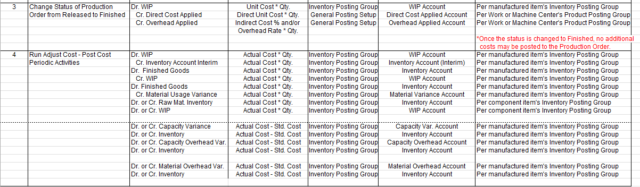
    Djon – Yes, the Direct Cost Applied Account is a funny account used for transacting Purchases, Manufacturing Labor, which is what you are talking about. To explain to others, I normally show them all the accounting entries made from Purchasing through Manufacturing. This way they see all entries using the Direct Cost Posting Setup column. When it comes to Purchasing, I normally explain that Direct Cost is contra to Purchase and the 2 accounts should net to zero each month. As for Manufacturing, Direct Cost Applied is used to capture the Direct Labor per Work or Machine Center’s Product Posting Group. Any Indirect/Overhead is posted to their respective Overhead Applied Account. Now that was a Credit to Direct Cost Applied and Debit to WIP. How does this eliminate, when you run Adjust Cost-Item Entries the WIP is relieved. Credit WIP and Debit Finished Goods. However, depending on your Costing Method, you will have additional entries like: Material Usage Variance, Capacity Variance, Overhead Variance, and Material Overhead Variance. To make this visual look at my pic attached.

    If you have more questions, reach out. schinsky@llconsultingservices.com

  • Djon Darko

    Member
    April 4, 2026 at 12:29 pm
    Up
    0
    Down
    ::

    Thanks for the reply Steve.

    However, what no one seems to talk about is the labour element and the sub contract costs consumed in the mfg process. The DCA account could apply here as well but how they clear out is not well known.

  • Ian Ray

    Member
    April 15, 2026 at 4:09 pm
    Up
    0
    Down
    ::

    The labor and subcontracting piece follows the same costing logic. Business Central treats both as production costs absorbed into the production order.

    For labor, the production capacity posting is WIP against Direct Cost Applied.

    For subcontracting, the subcontract purchase order posts a Capacity Ledger Entry on receipt and posts the invoiced direct cost to the production order.

    This follows standard manufacturing accounting under International Financial Reporting Standards (IFRS). Inventory cost includes “conversion costs” such as direct labor and other production costs. In the Business Central flow, these conversion costs are first capitalized into WIP.

Log in to reply.

Welcome to our new site!

Here you will find a wealth of information created for peopleĀ  that are on a mission to redefine business models with cloud techinologies, AI, automation, low code / no code applications, data, security & more to compete in the Acceleration Economy!