Microsoft Agent Building 101: The Five Kinds of Agent and When to Use Each

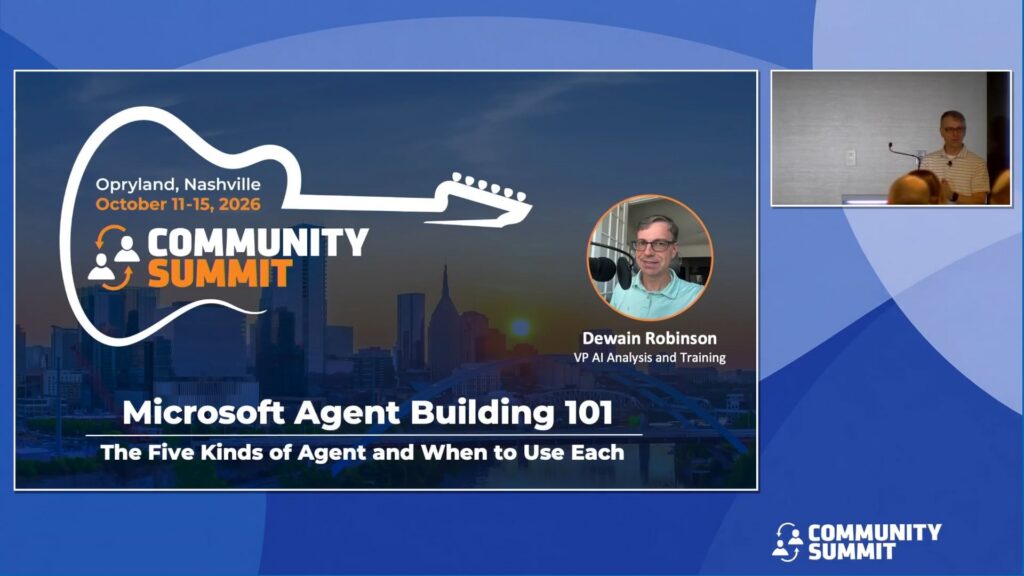
Session Overview: Most agent projects go wrong before a single thing gets built — at the moment someone picks the technology and then goes looking for a problem. Microsoft gives you five kinds of agent, and they sit on a
line from conversational to autonomous: chat agents that answer from your organization’s knowledge in
the flow of work, cowork agents that take a delegated task and hand back finished work, custom agents
purpose-built for a single business process, workflow agents that fire on an event and run a defined path,
and coding agents that build and maintain all the others. This session covers what each one is genuinely
for, and the harness decision that comes before the build decision. We’ll get into the concepts that make
them work — the orchestrator, memory, knowledge, tools, and skills; the continuous Thought → Action →
Observe → Decide loop; and why chain of thought lets an agent catch its own mistakes. Then we’ll map all
five onto real-world scenarios across financial services, retail, public sector, manufacturing, and logistics,
so you leave able to look at a business problem and name the right agent type with confidence.
Learning Objectives: 1
- Differentiate the five kinds of Microsoft agent — chat, cowork, custom, workflow, and coding — by how much work you hand over, and identify the scenarios each is built for.
- Choose the right harness before you build, distinguishing the Copilot, Standard, and GitHub Copilot harnesses by whether the path can be mapped up front or must be reasoned out live
- Explain the core building blocks every agent shares — orchestrator, model, memory, knowledge, tools, and skills — and how the Thought → Action → Observe → Decide loop and chain of thought drive real-world agent behavior.
Speakers: Dewain Robinson
Recorded at: Community Summit NA 2026
Type: Education Session
Ability Level: 101 – Beginner
Primary Product: Agents & Copilot
Terms: All rights reserved by the speaker, Community Summit NA, and Dynamic Communities and cannot be reproduced or distributed without express written consent by the speaker and Dynamic Communities.